No endless tables — just the differences that matter, and a clear call. Pick two tools and see who takes it.
Claude
AI Assistants
Anthropic's AI assistant built around safety and interpretability research, now featuring Claude 4.6 Opus with 1M token context in beta. Consistently ranks highest for long-document analysis, nuanced writing, and instruction-following accuracy. Claude Cowork provides enterprise-grade shared workspaces for team deployments.
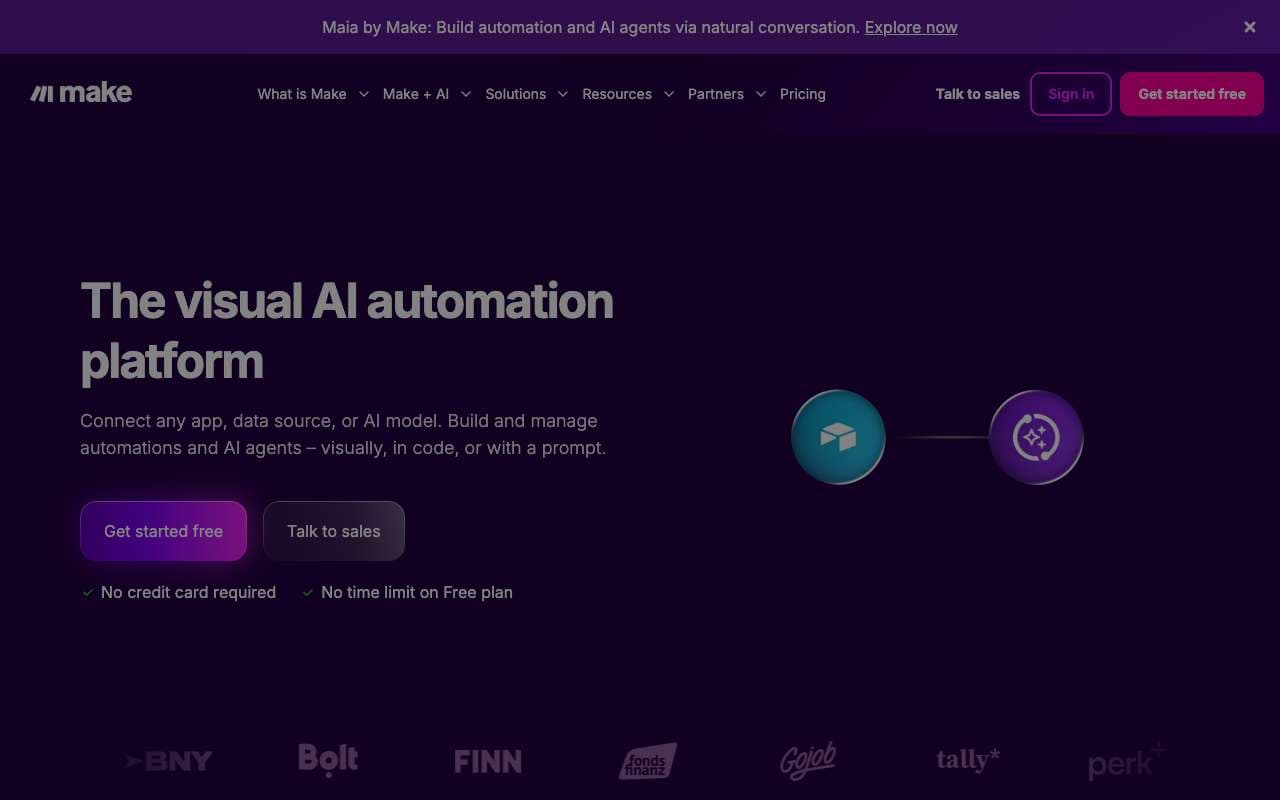
Visual automation platform (formerly Integromat) known for a scenario builder that makes data transformation and routing logic easier to visualize than Zapier's linear flow model. At $9-16/mo for 10,000-40,000 operations, it sits between free tools and enterprise platforms. Strong for teams doing complex multi-branch data processing without writing code.
Anthropic's AI assistant built around safety and interpretability research, now featuring Claude 4.6 Opus with 1M token context in beta. Consistently ranks highest for long-document analysis, nuanced writing, and instruction-following accuracy. Claude Cowork provides enterprise-grade shared workspaces for team deployments.
Category:AI Assistants
Features
Claude 4.6 Opus model with 1M token context (beta)
Extended thinking mode for multi-step reasoning problems
Artifacts: live code, SVG, and React component previews
Projects with shared knowledge bases across team members
Claude Cowork for enterprise shared workspace management
+3 more
Pros
Highest instruction-following accuracy among major assistants on MT-Bench as of Q1 2026
1M context allows loading entire codebases or book-length documents without chunking
Extended thinking produces auditable reasoning chains, useful for regulated industries
Anthropic Constitutional AI training results in fewer harmful outputs without excessive refusals
Cons
Free tier caps out at ~20 messages per day on Claude 4.6 Sonnet; Opus access requires Pro plan
No native image generation — cannot produce images, only analyze them
Claude Cowork enterprise pricing requires sales call; no self-serve above Pro tier
1M context is beta-only and not available on free/Pro plans as of March 2026
Slower inference on Opus 4.6 than competing models at equivalent pricing
Visual automation platform (formerly Integromat) known for a scenario builder that makes data transformation and routing logic easier to visualize than Zapier's linear flow model. At $9-16/mo for 10,000-40,000 operations, it sits between free tools and enterprise platforms. Strong for teams doing complex multi-branch data processing without writing code.
Category:Workflow Automation
Features
Visual scenario builder with non-linear, branching workflow visualization
2,000+ app integrations including HTTP/REST and webhooks for custom APIs
Advanced router modules for conditional branching and data filtering
Data store: built-in lightweight database for state persistence between scenarios
JSON/XML parsing and transformation with no-code tools
+3 more
Pros
Non-linear visual builder is significantly clearer than Zapier for workflows with multiple branches and conditions
Operations-based pricing means 1 automation with 5 steps costs 5 ops — often cheaper than per-task Zapier pricing
Data Store allows state to persist between runs without an external database for simple key-value use cases
Free tier includes 1,000 operations/month — enough for testing before committing to a paid plan
Cons
AI node support is limited compared to n8n — building LLM pipelines requires more manual HTTP module work
Scenario builder becomes visually complex (hard to read) on workflows with 30+ modules
Free tier requires manual scenario activation — paid plan required for scheduled automatic runs
No self-hosting option — all data flows through Make's cloud infrastructure
Cost scales linearly with operation count, not workflow count; high-frequency scenarios become expensive at $9/mo base
Anthropic's AI assistant built around safety and interpretability research, now featuring Claude 4.6 Opus with 1M token context in beta. Consistently ranks highest for long-document analysis, nuanced writing, and instruction-following accuracy. Claude Cowork provides enterprise-grade shared workspaces for team deployments.
Visual automation platform (formerly Integromat) known for a scenario builder that makes data transformation and routing logic easier to visualize than Zapier's linear flow model. At $9-16/mo for 10,000-40,000 operations, it sits between free tools and enterprise platforms. Strong for teams doing complex multi-branch data processing without writing code.
Features
Claude 4.6 Opus model with 1M token context (beta)
Extended thinking mode for multi-step reasoning problems
Artifacts: live code, SVG, and React component previews
Projects with shared knowledge bases across team members
Claude Cowork for enterprise shared workspace management
Vision: image and PDF analysis with positional referencing
Computer-use API for browser and desktop automation
Model Context Protocol (MCP) for tool integrations
Visual scenario builder with non-linear, branching workflow visualization
2,000+ app integrations including HTTP/REST and webhooks for custom APIs
Advanced router modules for conditional branching and data filtering
Data store: built-in lightweight database for state persistence between scenarios
JSON/XML parsing and transformation with no-code tools
Scenario scheduling: minute-level granularity on triggers
Error handling routes for automatic retry and failure notification
Team features: shared scenarios, scenario logs, version history
Pros
Highest instruction-following accuracy among major assistants on MT-Bench as of Q1 2026
1M context allows loading entire codebases or book-length documents without chunking
Extended thinking produces auditable reasoning chains, useful for regulated industries
Anthropic Constitutional AI training results in fewer harmful outputs without excessive refusals
Non-linear visual builder is significantly clearer than Zapier for workflows with multiple branches and conditions
Operations-based pricing means 1 automation with 5 steps costs 5 ops — often cheaper than per-task Zapier pricing
Data Store allows state to persist between runs without an external database for simple key-value use cases
Free tier includes 1,000 operations/month — enough for testing before committing to a paid plan
Cons
Free tier caps out at ~20 messages per day on Claude 4.6 Sonnet; Opus access requires Pro plan
No native image generation — cannot produce images, only analyze them
Claude Cowork enterprise pricing requires sales call; no self-serve above Pro tier
1M context is beta-only and not available on free/Pro plans as of March 2026
Slower inference on Opus 4.6 than competing models at equivalent pricing
AI node support is limited compared to n8n — building LLM pipelines requires more manual HTTP module work
Scenario builder becomes visually complex (hard to read) on workflows with 30+ modules
Free tier requires manual scenario activation — paid plan required for scheduled automatic runs
No self-hosting option — all data flows through Make's cloud infrastructure
Cost scales linearly with operation count, not workflow count; high-frequency scenarios become expensive at $9/mo base