By Assaf Biton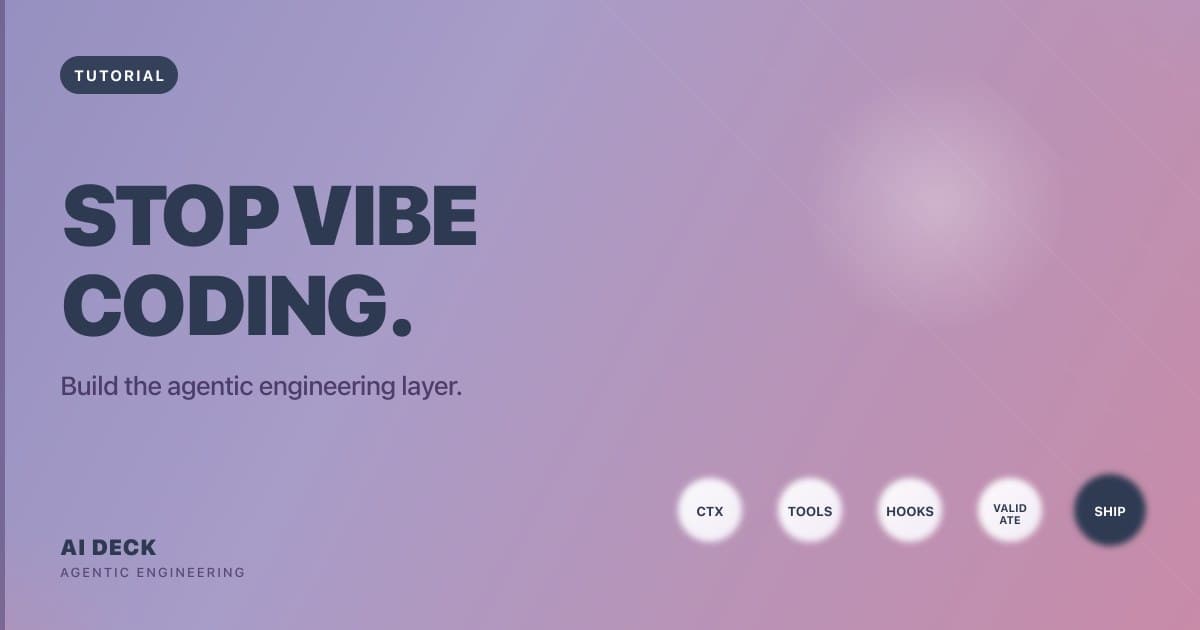
Anthropic's terminal-based autonomous coding agent powered by Claude Opus 4.6 with 1M token context. Runs 30-hour autonomous tasks with access to your filesystem, shell, and test runners. Native IDE extensions for VS Code and JetBrains allow inline use alongside Cursor-style editing. Scores 74.4%–80.9% on SWE-bench Verified.
Best for: Senior developers who want to delegate long autonomous tasks and review results, DevOps teams integrating AI into CI pipelines for automated test fixing
I used to think the next jump in AI coding would come from a stronger model. After reading through the agent transcripts, the pattern looks different. The best teams are not just prompting harder. They are building a layer around the codebase that tells agents where to look, what they can touch, how they should work, and when they are actually done.
TL;DR: Agentic engineering is the operating layer around an AI coding agent. It combines context files, workflow scripts, scoped tools, safety hooks, isolated environments, and validation loops so an agent can work without turning your repo into a guessing game.
Research base: This guide is a synthesis of AI Deck's local research notes on agentic engineering, Claude Code hooks, Pi agent teams, validation rigs, and transcript analysis from 9 deep YouTube breakdowns. Treat vendor metrics as directionally useful until you verify the original source.
What Agentic Engineering Actually Means
Agentic engineering is not a fancy name for asking Claude Code or Cursor to "build the feature." That is still just prompting. Sometimes it works. Sometimes it leaves you with a patch you cannot explain and a test suite you are afraid to run.
The better definition from the research is simpler: you know what the system will do well enough that you do not need to watch every step. Not because you trust the model. Because you built rails around it.
That is the gap between vibe coding and agentic engineering. Vibe coding asks the model to figure out the workflow. Agentic engineering gives the model a workflow and asks it to execute inside boundaries.
| Dimension | Vibe Coding | Agentic Engineering |
|---|---|---|
| Starting point | A broad prompt in chat | A written brief with scope, constraints, and done criteria |
| Context | The model searches until it feels oriented | The repo tells the agent which files, docs, and commands matter |
| Tools | Everything is exposed all the time | Tools are scoped by task, phase, and risk level |
| Safety | You hope the agent asks before doing something risky | Hooks block, pause, or route dangerous actions |
| Completion | The agent says it is done | Tests, checks, review loops, and artifacts decide whether it is done |
The Layer Has 5 Parts
When you strip away the names, most serious agent setups keep repeating the same shape. I would not start with a new model. I would start with these 5 pieces.
1. A Context Contract
Your agent needs a short path into the codebase. That can be an AGENTS.md, CLAUDE.md, repo map, skill file, or a prime command. The format matters less than the promise: "When you work here, read these things first and follow these rules."
Good context contracts are boring. They include package manager rules, test commands, dangerous paths, common workflows, and domain language. The point is not to impress the agent. The point is to stop it from rediscovering the same facts on every task.
2. Workflow Code
The strongest pattern in the transcript research is not "let the model do everything." It is code plus agent reasoning. Deterministic steps handle the parts that should not be creative: install, format, lint, test, diff, commit checks, validation, and report generation.
The model handles the uncertain parts: deciding what to change, reading failures, adapting the plan, and explaining tradeoffs. This is where blueprint-style workflows make sense. You are not replacing engineering discipline with an agent. You are turning engineering discipline into something the agent can run.
3. Scoped Tool Discovery
Too many tools can make an agent worse. Every exposed tool adds context, choices, and failure modes. The research keeps coming back to the same answer: do not dump every MCP server, script, and command into every session.
Use a tool catalog. Let the agent discover the right tool for the current phase. For background, see our guide to MCP for AI agents, but the practical rule is even simpler: if a tool is not needed for this task, it should not be in the agent's head.
4. Safety Hooks
This drove me nuts in the research: teams talk about autonomy before they talk about damage control. That is backwards. An agent that can edit files and run bash needs guardrails before it needs more autonomy.
Start with boring protections. Block destructive shell patterns. Protect .env, .ssh, production configs, and package lockfiles. Ask before database commands. Keep global hooks for device-level protection and project hooks for repo-specific rules.
5. Validation Loops
An agent saying "done" is not a completion signal. It is a claim. Completion should come from checks: tests pass, types pass, lint passes, build passes, screenshots match, migrations are reversible, and the diff makes sense.
For higher-risk work, use a builder-validator pattern. One agent builds. A separate review pass checks the result with fresh context. That costs more tokens. Fine. A bad autonomous patch costs more than a second model pass.
Pro Tip: Build the first version with 5 artifacts: repo map, task brief template, plan-build-review command, dangerous-command hook, and a verification checklist. That gets you most of the value before you touch multi-agent orchestration.
Why Blueprints Beat Agent-Only Workflows
The Stripe Minions research is useful even if you ignore the headline metrics. The interesting lesson is architectural: a serious agent system does not ask the model to remember every company-specific step. It encodes repeatable steps as workflows.
Think about a normal coding task. There is the creative part: understand the issue, pick an approach, modify the code. Then there is the ritual part: run the right tests, inspect the diff, update the docs, open a PR, add review notes, handle CI. The ritual part should not be improvised every time.
Blueprints solve that. They let deterministic code carry the boring, failure-prone steps while the model works inside the lanes where judgment matters. Honestly? This is the most human part of the whole system. Senior engineers already work this way. They do not think from scratch on every ticket. They run a practiced loop.
| Workflow Step | Better as Code | Better as Agent Judgment |
|---|---|---|
| Repo orientation | Load fixed docs, read status, list changed files | Decide which subsystem matters |
| Planning | Require a plan file or structured checklist | Choose the smallest credible implementation path |
| Implementation | Run formatters and exact test commands | Write and revise the code |
| Review | Gather diff, logs, screenshots, coverage | Judge risk, missing cases, and weird edge behavior |
| Handoff | Write paths, commands, status, blockers | Explain what changed and what still feels risky |
The Safety Layer Is Not Optional
If an agent can run bash, it can do real damage. It does not need bad intent. A wrong assumption is enough. The hook research makes this very concrete: block known dangerous patterns with deterministic rules, then use prompt-based checks only for fuzzy cases that do not fit clean patterns yet.
Well, actually, even approval prompts are not enough. If every command asks for approval, the human becomes a sleepy enter key. Good safety design should reduce approval fatigue. It should block obvious danger, ask only for meaningful ambiguity, and leave safe operations alone.
Do not treat a worktree as a security boundary. It protects your branch organization, not your secrets, shell, browser profile, home directory, or network access. For real isolation, use a separate OS user, container, VM, or remote sandbox.
For a deeper risk map, read our AI agent security guide. The short version: autonomy without access design is not engineering. It is exposure.
A Practical Starter Architecture
You do not need a 9-agent boardroom to start. In fact, please do not start there. Start with a layer you can inspect in one afternoon.
| Layer | Artifact | Job | First Version |
|---|---|---|---|
| Orientation | AGENTS.md |
Tell agents how this repo works | Package manager, tests, folder map, risk rules |
| Briefing | task-brief.md |
Force clean inputs before execution | Goal, constraints, files, done criteria |
| Workflow | /plan-build-review |
Keep work in phases | Plan, edit, verify, review, handoff |
| Safety | Pre-tool hooks | Control shell and file risk | Block destructive commands and protected paths |
| Validation | Check script | Decide if the work is real | Types, tests, lint, build, screenshot if UI |
| Memory | Run ledger | Make future agents smarter | What happened, commands run, next pointer |
This also connects to AI memory. A memory system is not just "remember my preferences." In agentic engineering, memory is operational: what broke last time, which tests are slow, which files are dangerous, which commands are allowed, which decisions were already made. See our Zep vs Mem0 vs Letta comparison for the broader memory tradeoffs.
How To Build Your First Agentic Layer This Week
Here is the version I would actually build first. It is intentionally small.
- Pick one repo. Do not design a universal agent operating system on day 1. Choose the repo where agents already waste the most time.
- Write the repo contract. Add package manager rules, commands, folder ownership, sensitive paths, and how to verify work.
- Create a task brief template. Require the user or agent to state scope, target files, risks, and completion checks before editing.
- Add a plan-build-review workflow. The agent plans first, edits second, verifies third, and reviews the diff last.
- Install safety hooks. Block obvious destructive shell commands and protect secrets, local config, and generated artifacts.
- Add a verification script. One command should run the checks that matter for this repo. If there are multiple lanes, document them.
- Keep a run ledger. Every agent run should leave enough context for the next run to know what happened and where to continue.
That gives you a working layer before you add subagents, MCP gateways, custom dashboards, or model routing. And it gives you a clean way to evaluate whether those extras are worth it.
What Not To Build Yet
The research is full of tempting ideas: agent teams, long-context boards, private skill libraries, Tool Shed-style registries, cross-runtime orchestration, and persistent multi-device agent systems. Some of that is genuinely useful. But most teams should earn it.
Do not build a multi-agent stack until a single-agent workflow is reliable. Do not add a dashboard before your handoff files are useful. Do not expose 47 tools because it feels powerful. Do not chase local models for critical planning if they cannot hold the context. And do not let the agent self-certify high-risk work.
Long story short: make the small loop boring first. Then scale it.
FAQ
Is agentic engineering just prompt engineering?
No. Prompt engineering changes the instruction. Agentic engineering changes the working environment around the instruction: context, tools, permissions, workflow, validation, and memory.
Do I need multiple agents?
Not at first. A single agent with a good brief, a scoped workflow, safety hooks, and verification checks will beat a messy agent team in most repos. Add a reviewer agent only when the work is risky enough to justify the extra cost.
Should I use MCP for everything?
No. MCP is useful when a tool really belongs in the agent's workflow. But every exposed tool adds context and risk. For many repo tasks, a simple CLI command or local script is cleaner than another always-loaded tool surface.
How does this relate to AutoResearch?
AutoResearch is the same idea applied to ML experiments: one loop, clear metric, immutable evaluation, and automatic keep-or-revert behavior. The lesson transfers well to coding agents. Give the agent a measurable loop, not a vague wish.
Our Recommendation
Start here: Build a repo-specific agentic layer before buying or inventing a larger agent platform.
Best first artifact: A serious AGENTS.md plus a plan-build-review workflow. It gives the model context, gives you control, and makes future automation easier.
Best upgrade: Add safety hooks and a separate validation pass once agents touch production code, secrets, migrations, or customer-facing UI.
The Bottom Line
The next step in AI coding is not "trust the agent more." It is "make trust less necessary." That means fewer loose prompts, fewer mystery tool calls, fewer giant context dumps, and fewer final answers that pretend to be verification.
Build the layer. Teach the agent how your repo works. Give it a workflow. Restrict the dangerous parts. Make completion observable. Then, when you add stronger models or more agents, they will have somewhere sane to operate.